Projects
A scrollable view of my research program, from Arctic cloud states and climate intervention to particle-scale mixing and precipitation formation.
My research connects particle-scale cloud physics with cloud evolution, precipitation, radiation, and climate. The sections below approach that connection through cloud regimes, deliberate intervention, mixing, rain formation, and model development.

Research thread · 01
Arctic Cloud States and Microphysics
How cloud variability, phase changes, and particle histories shape Arctic winter
Arctic winter can alternate between strongly cooling clear conditions and heat-trapping liquid-bearing clouds. My research connects that large-scale pattern to processes that happen much faster and much smaller: liquid-water fluctuations, ice growth, and the trajectories of individual hydrometeors.
Why does Arctic winter switch between radiative states?
I use long-term observations and stochastic dynamics to investigate how cloud variability maintains contrasting clear and cloudy states, and why atmospheric models often blur them into an unrealistic intermediate state.
How does cloud physics interact with a changing Arctic climate?
I investigate the two-way link between Arctic cloud microphysics and climate: how cloud processes shape Arctic climate regimes, and how climate change alters those processes in turn.
How do particle histories shape mixed-phase clouds?
I compare observations with particle-based and bulk models to understand how ice growth, transport, and cloud dynamics organize persistent mixed-phase clouds.
Research thread · 02
Climate Intervention
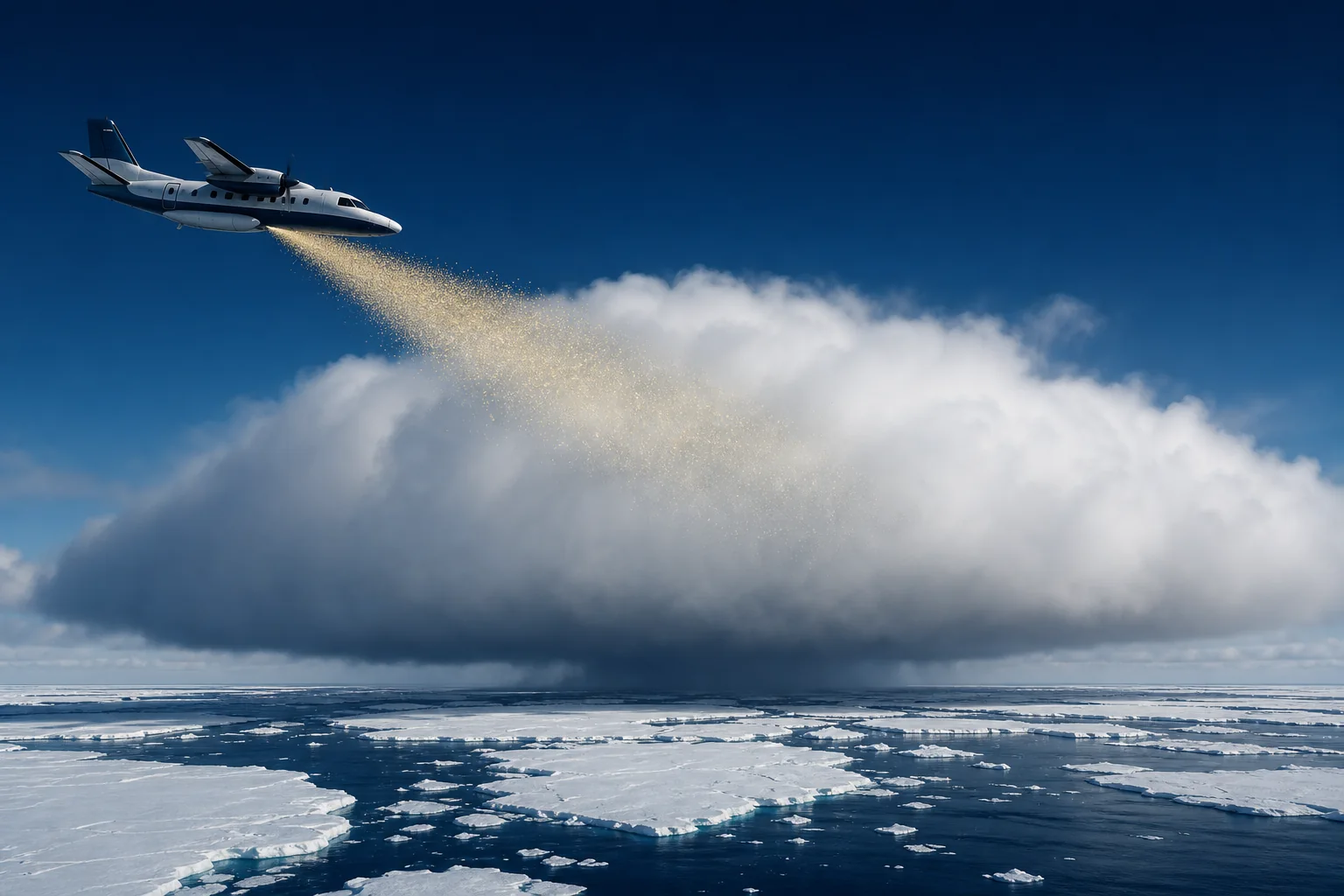
Evaluating intervention outcomes across observed Arctic weather regimes
I use large-eddy simulations to test when proposed cloud interventions can meaningfully alter Arctic clouds and radiation, and why their outcomes depend on the surrounding atmospheric state.
How do weather regimes control intervention outcomes?
I evaluate intervention responses across observed synoptic environments to identify the cloud and meteorological conditions that amplify, limit, or reverse the intended response.

Research thread · 03
Entrainment & Mixing
How turbulent mixing reshapes cloud droplet populations
Entrainment brings dry environmental air into a cloud, where turbulent mixing changes the histories of individual droplets and can redirect the cloud’s evolution toward persistence or precipitation.
How does mixing reshape droplet populations?
Dry-air mixing can evaporate droplets unevenly, broaden or narrow the droplet-size distribution, and change how a cloud evolves toward rain. I examine when mixing behaves homogeneously or inhomogeneously and which environmental conditions move it between those regimes.
How can particle histories reveal the mixing pathway?
I use high-resolution Lagrangian cloud simulations to follow individual droplets through entrainment events. Their trajectories connect the thermodynamic history of mixing to the evolving droplet-size distribution rather than only its final snapshot.
Selected publications
- Lim & Hoffmann (2026): Aging of droplet size distribution in stratocumulus clouds: regimes of droplet size distribution evolution. Atmospheric Chemistry and Physics
- Lim & Hoffmann (2024): Life cycle evolution of mixing in shallow cumulus clouds. JGR: Atmospheres
- Lim & Hoffmann (2023): Between broadening and narrowing: How mixing affects the width of the droplet size distribution. JGR: Atmospheres
Research thread · 04
Warm Rain Initiation
How precipitation embryos help clouds cross the size gap to rain
Warm clouds can produce rain rapidly even though condensational growth alone cannot efficiently grow ordinary cloud droplets to collision-ready sizes.
Why is warm rain difficult to initiate?
Condensation typically grows droplets to only 10–15 micrometers, while collision–coalescence becomes efficient closer to 40 micrometers. This size gap is a central obstacle to explaining rapid rain onset.
Can giant aerosols bridge the size gap?
Giant and ultra-giant aerosol particles can activate into unusually large droplets that act as precipitation embryos, begin colliding earlier, and accelerate the coalescence cascade.
What controls the acceleration of rain formation?
Using Lagrangian cloud simulations, I quantify the number and size of precipitation embryos required for earlier rain and examine how their effects interact with turbulence and the surrounding droplet population.
Selected publication
- Lim, Noh, Lee & Hoffmann (2025): The critical number and size of precipitation embryos to accelerate warm rain initiation. Atmospheric Chemistry and Physics
Research infrastructure · 05
Model development
I develop cloud models and research software for studying particle-scale physics in idealized and high-resolution simulations.
DropLab development
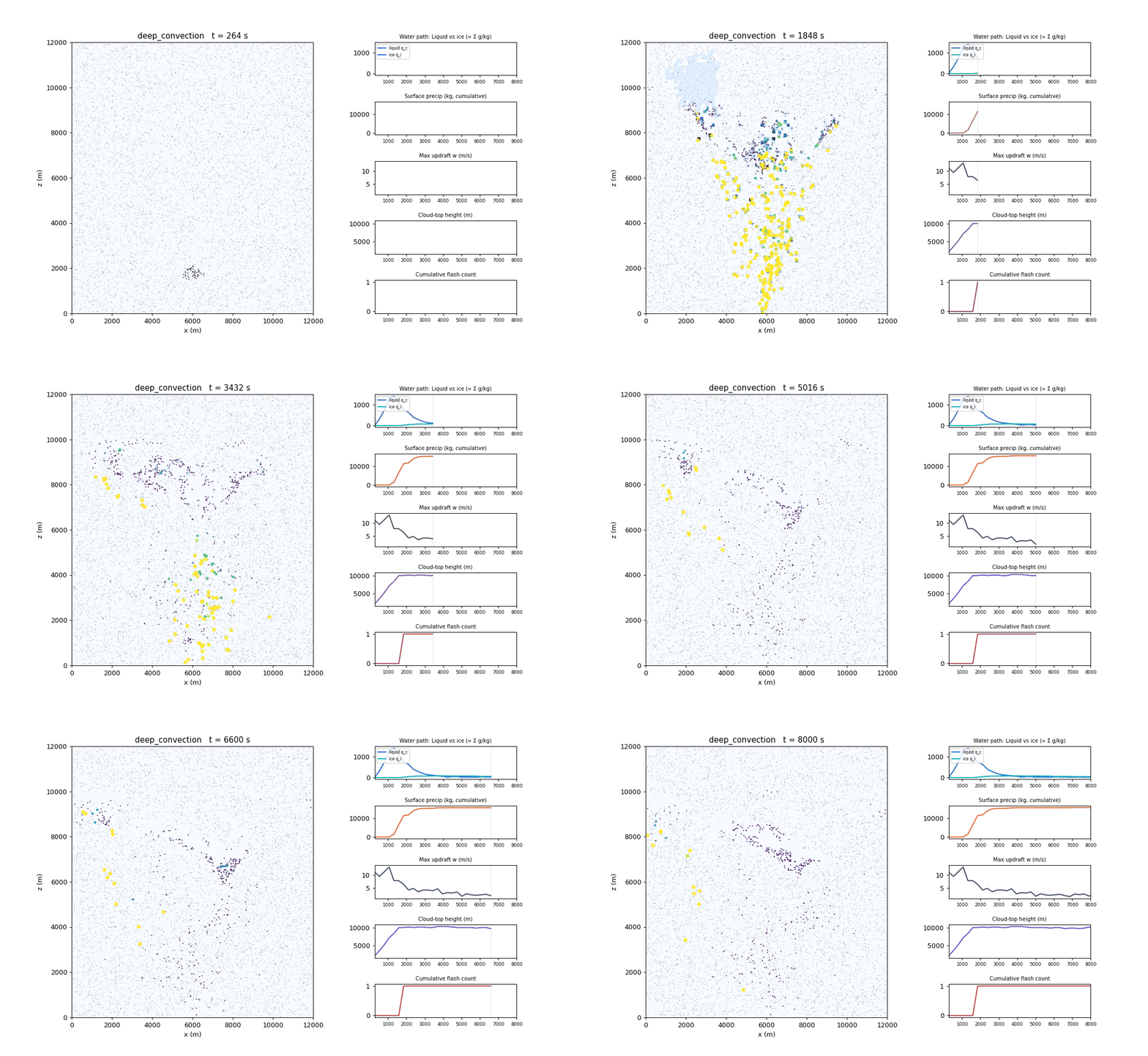
I develop DropLab, an open-source Lagrangian cloud laboratory for research exploration and teaching. It connects individual super-droplet histories to parcel, cloud-deck, and deep-convection experiments that can run on a laptop.
GPU-accelerated particle-based microphysics in LES
I am developing GPU-accelerated particle-based microphysics for the Lagrangian Cloud Model (LCM), coupled to the System for Atmospheric Modeling (SAM), using OpenACC on NVIDIA GPUs. Ongoing end-to-end benchmarks show 17–38× speedups across the cases tested so far; validation and performance benchmarking are ongoing.